How can we make existing bridges safer, longer-lasting, and more cost-effective?
This question was the focus of the joint event “Saving bridges with AI and BIM,” organized by the BIM Cluster NRW and the North Rhine-Westphalia Chamber of Civil Engineers, which took place on September 14 at the Baukunstarchiv in Dortmund.
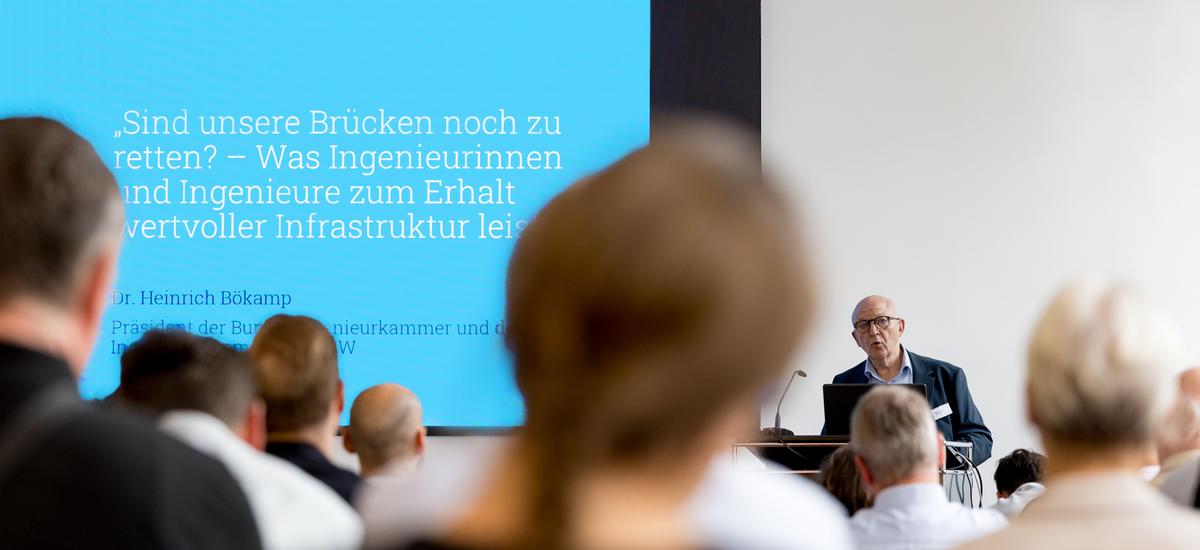
To kick off the event, Dr. Heinrich Bökamp, President of the North Rhine-Westphalia Chamber of Civil Engineers and the Federal Chamber of Engineers, emphasized the social importance of a functioning infrastructure. Innovative and digital methods can help, he said, with assessing the condition of structures more accurately to ensure maintenance measures are optimized, although the technical assessment and responsibility remain with the engineers.
Dr. Otto Wurzer of WTM Engineers used the example of the upgrading of the Donauwörth Bridge over the Danube to demonstrate how engineering expertise and new technologies dovetail in practice. The aim of the project: through careful reinforcement to preserve and continue to use the prestressed concrete structure, which dates from the 1960s.
The project combines various innovative approaches: Among other things, carbon concrete is being used to reinforce the structure, while a detailed BIM as-built model, together with survey data and non-destructive testing methods, lays the foundations for the repair planning. Radar and ultrasonic measurements, as well as AI-supported analysis methods, help to precisely locate tendons and reinforcement within the structure, and later on extensive structural monitoring will be used to verify the success of the upgrade.
This is an example of the potential that lies in combining experience, engineering expertise, and digital methods when it comes to sustainable maintenance of existing infrastructure.